
REAL-WORLD IMPACT
What does AI implementation actually deliver?
Select the sector closest to your business to see representative outcomes from similar organizations — grounded in published industry research.
Plumbing & mechanical subcontractor, 12 employees
Commercial and multi-residential projects — Ontario region
The owner and office manager were spending 3–6 hours per commercial or multi-residential bid — covering material takeoffs, supplier pricing checks, subcontractor coordination, and proposal writing. Client progress updates were written manually or skipped entirely, generating complaints despite solid on-site work quality.
What changed after implementation- Complex bid preparation reduced to under 90 minutes — consistent with McKinsey's finding that AI-enabled estimating reduces time by up to 50% on detailed bids
- Capacity to pursue significantly more bids per week with the same office staff
- Automated weekly client progress updates — one contractor who made this change reported his Google rating improving from 4.2 to 4.7 within 90 days
- Invoice processing time cut by approximately 70% through automation
- Estimated 10–12 hours per week recovered across estimating, invoicing, and client communication combined
The work didn't change. The systems running it did.
Grounded in: McKinsey finding that AI-enabled estimating reduces time by up to 50% on complex construction bids; industry data showing 30–50% admin reductions in trades businesses using workflow automation (Construction AI Adoption Report, 2026); single contractor-reported Google review outcome via trades publication

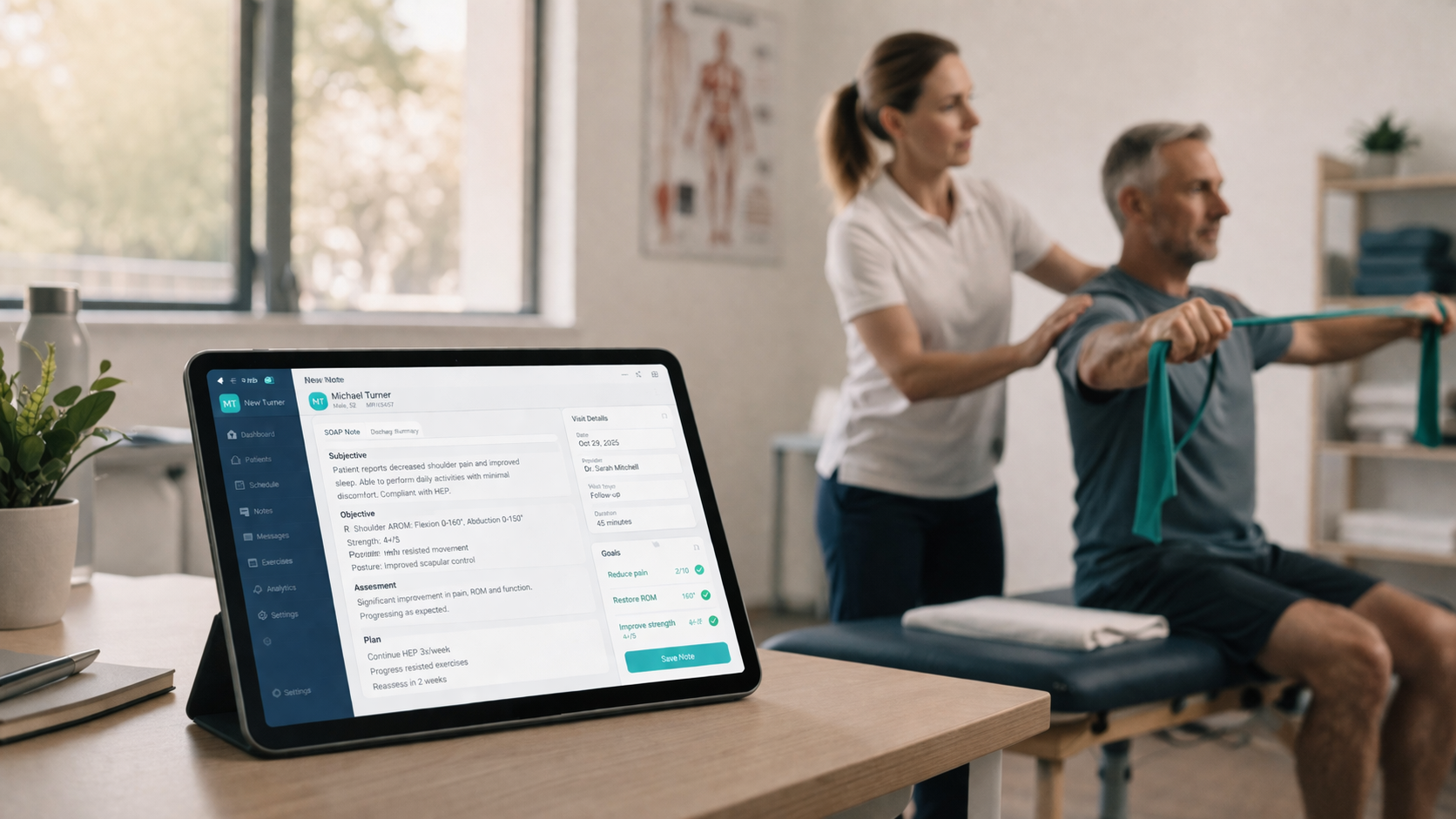
Allied health clinic, 8 staff, 3 practitioners
Physiotherapy & rehabilitation — private practice
Each clinician was carrying up to 2 hours of daily administrative burden — across clinical documentation, scheduling coordination, and insurance correspondence — in addition to their patient caseload. Staff turnover was elevated. The APTA identifies administrative burden as a top contributor to clinician burnout and retention loss.
What changed after implementation- Clinical documentation time meaningfully reduced through AI-assisted note drafting — practitioners reviewing and approving rather than building notes from scratch
- Admin staff time on manual data entry reduced by approximately 60% through intake and scheduling automation
- Practitioner capacity increased without adding headcount — more patients seen with less end-of-day administrative carry-over
- Staff reported reduced administrative fatigue within 30 days of implementation
- Automated follow-up sequences introduced for referrals and rebooking — previously handled manually or not at all
The care didn't change. The burden around it did.
Grounded in: APTA 2023 survey identifying admin burden as a top driver of PT burnout; healthcare AI research showing $3.20 return per $1 invested within 14 months across healthcare organisations broadly; Microsoft/Forrester SMB study showing 132–353% ROI from AI workflow implementation over three years
Boutique accounting firm, 6 staff
Bookkeeping & advisory — SMB client base
The team was spending disproportionate time on client onboarding, routine inquiry responses, and monthly reporting assembly. New client onboarding required multiple back-and-forth communications over several days before work could begin. During peak periods, 50+ hour weeks were the norm. Client communication was reactive rather than proactive.
What changed after implementation- Client onboarding that previously required multiple touchpoints over 2–3 days was reduced to a single automated intake workflow completed in one session
- Monthly reporting assembly time cut by approximately 65% through automated data aggregation and report drafting
- Routine inquiry response time reduced from same-day to within the hour through AI-drafted responses for review
- Peak season overtime estimated to have reduced by approximately 30% — staff described work as measurably more sustainable within 60 days
- Client communication shifted from reactive to proactive through automated milestone and update sequences
Revenue didn't change in month one. Capacity did — and capacity is what growth requires.
Grounded in: Forrester/Microsoft finding that SMBs experience 132–353% ROI from AI workflow implementation over three years; public SME automation data showing up to 80% reduction in manual invoice and report processing time; 65% reporting figure consistent with published accounting automation outcomes

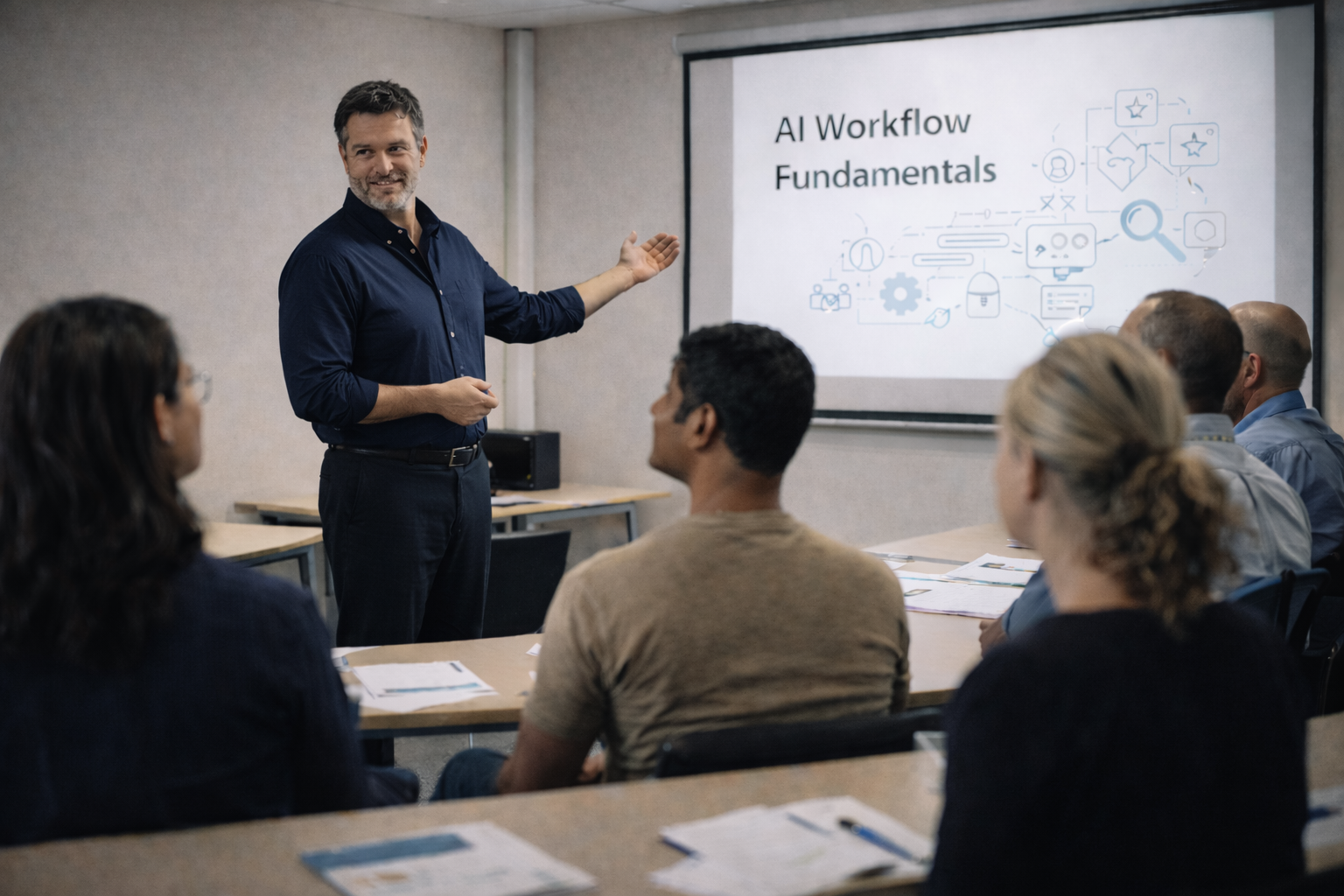
Private training provider, 4 staff
Professional development & workshops — associations and SMBs
Building new workshop content from scratch was taking 3–4 weeks per offering — covering research, curriculum design, materials, and participant resources. The business had ideas for three new offerings but no capacity to develop them. Post-workshop follow-up was inconsistent, reducing repeat bookings and referrals.
What changed after implementation- New workshop development from scratch reduced to 5–7 days — AI assisting with research synthesis, draft structuring, and materials, with the facilitator directing and refining throughout
- Three new service offerings developed and launched within 6 months — previously impossible with existing capacity
- Post-workshop feedback reports generated automatically and available within 24 hours of each session
- Participant communication — confirmations, pre-work, follow-up sequences — fully automated with zero additional staff time
- Owner reclaimed approximately 8 hours per week previously spent on administrative content work
The expertise was always there. The capacity to deploy it wasn't — until the engine changed.
Grounded in: IDC/Microsoft finding that organisations investing in AI workflows achieve average 3.7× ROI; Forrester data showing 24–27% improvement in time-to-market for new product and service offerings among SMBs using AI tools; workshop timeline consistent with instructional design practice for new-content development
Illustrative scenarios based on published industry research and typical engagement outcomes. Results vary by scope, business context, and implementation approach. Percentage improvements and time estimates are grounded in peer-reviewed or primary-source research — attributions included within each scenario. Single-organisation outcomes are noted as reported, not as benchmarks.

WHERE TO BEGIN
Walk away knowing exactly where AI fits in your business — and what to do first.
Most businesses don't have an AI problem. They have a clarity problem. A focused conversation about your operations — how work actually gets done, where time is lost, and where the real opportunities are — changes that. No pitch. No obligation.